


Somewhere in central Taiwan, it is past midnight, and tens of thousands of pilgrims are walking through the dark. They follow a gilded palanquin bearing the goddess Mazu on her annual journey across the island, guided not by the stars above but by a glowing dot on their smartphones. Welcome to Taiwan, where the divine and the digital have been best friends for years.
Taiwan is often celebrated for its technology, its cuisine, its breathtaking mountains and bustling night markets. But there is something else quietly extraordinary about this island: its relationship with faith. In few places on earth does religion weave so naturally into the rhythm of daily life: not as obligation, not as controversy, but as something closer to breathing. And in few places has ancient belief adapted so fluidly to the modern world without losing a single thread of its soul.
Three in One: A Spiritual Philosophy
To understand Taiwanese folk religion, forget everything you know about the tidy separation of faiths. In Taiwan, the dominant spiritual tradition is a seamless blend of Confucianism, Taoism, and Buddhism — a philosophical ménage à trois that has produced one of the world's most harmonious religious cultures.
From Confucianism comes the moral scaffolding: filial piety, loyalty to community, respect for teachers and elders. Taoism supplies the rituals: the vivid temple ceremonies, the practices of warding off evil, the pursuit of balance with nature. Buddhism layers in a deeper cosmology: karma, reincarnation, and the compassionate desire to relieve suffering. Walk into almost any Taiwanese temple and you may find deities from these traditions sharing neighboring temples or even altars without any apparent theological dispute. To outsiders who have lived through centuries of religious warfare, it can seem almost miraculous. To Taiwanese people, it is simply Tuesday.

The Gods Next Door
The Taiwanese pantheon is vast, colorful, and refreshingly practical. These are gods with jobs.
Mazu(媽祖), the Queen of Heaven, began as the patron of fishermen on the treacherous Taiwan Strait. Over centuries, her protection expanded until she became something like the island's spiritual mother, worshipped in over 510 temples (considering Taiwan is only 36,197 square kilometers, that is an impressive density). Her temples are among the most spectacular in Asia: dragon-wrapped pillars, incense clouds so thick they soften the sunlight, offerings piled high with fruit and flowers.
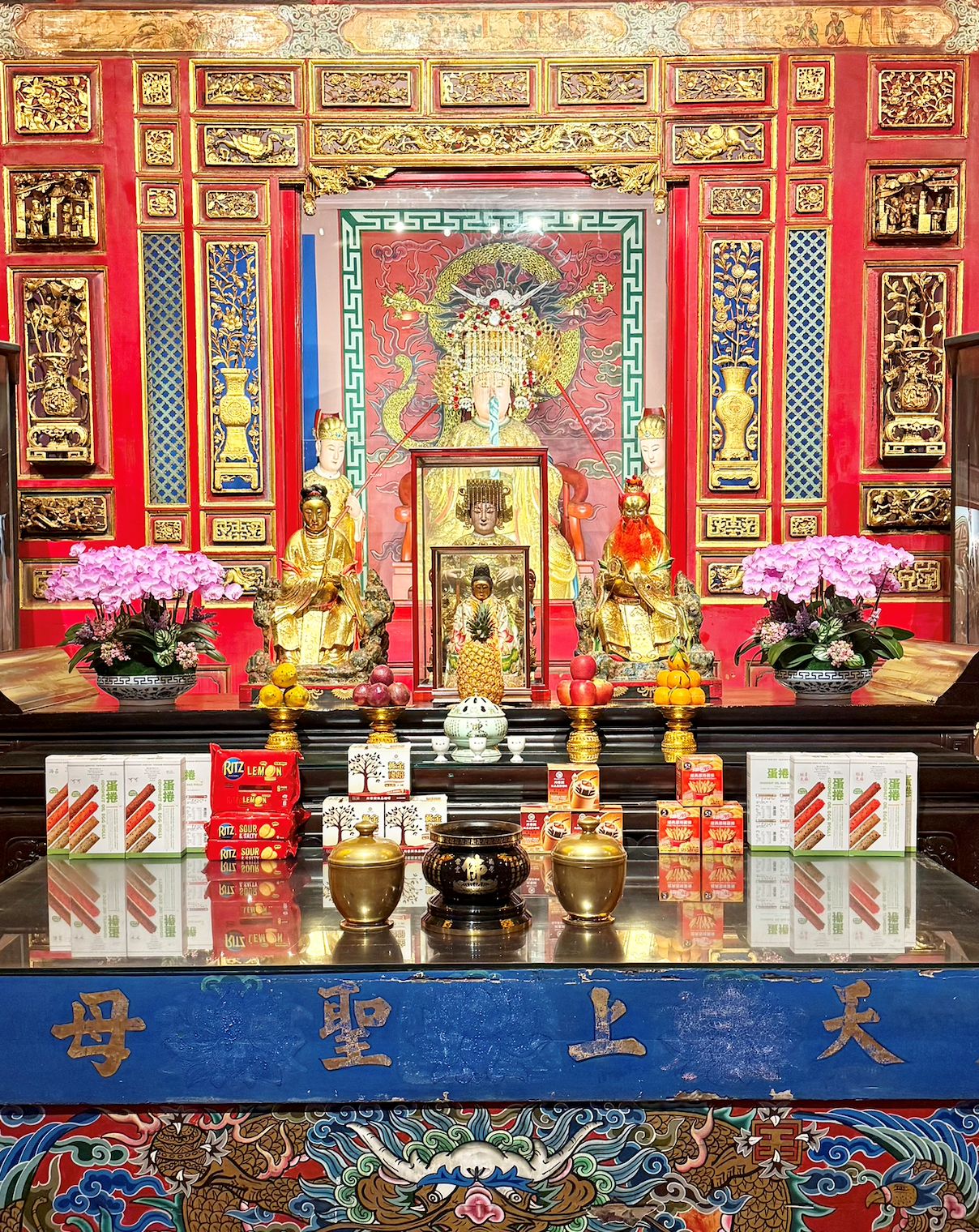
Tudigong(土地公), the humble Earth God, is the neighbourhood deity. He is a gentle bureaucrat of the divine world who handles agricultural fertility, business luck, and community harmony. You will find small shrines to him tucked under trees, beside roads, inside shops. In a country where small businesses are the economic heartbeat, Tudigong never lacks for visitors.

Then there is Guanyu(關羽), the deified general whose moral authority is so formidable that both police officers and gang members place him on their altars. He is simultaneously the god of righteousness, commerce, and academic achievement. Visit our previous article to learn more about this divine multitasker in the multitasking society of Taiwan.

And for matters of the heart, there is Yuelao(月老), the Old Man Under the Moon, who ties the red threads of fate that bind future couples. Young people flock to his shrines not only for romance but, increasingly, for friendship, social confidence, and — in a charming sign of the times — smooth ticket purchases for their favourite pop star's concert.

Mazu Goes Digital
The annual Mazu pilgrimage during the third lunar month is Taiwan's largest religious event, and one of the most extraordinary on earth. In 2004, Discovery Channel named it one of the world's three major religious festivals, alongside the Hajj to Mecca. Hundreds of thousands of pilgrims follow the goddess's palanquin for approximately nine days and over 300 kilometres across the island — sleeping in temples, eating food donated by strangers, arriving sweaty and blistered and, by all accounts, deeply moved.
In the digital age, the pilgrimage has not diminished, it has expanded. Last year, a live stream of the Baishatun Mazu pilgrimage drew over 700,000 viewers, allowing Taiwanese diaspora in Los Angeles, Tokyo, and Frankfurt to watch in 4K resolution as the palanquin moved through elementary schools, winding alleys and moonlit rice fields. A dedicated app allows followers to track the goddess's precise GPS location in real time, which is vital information, since Mazu's route is famously spontaneous, determined not by a fixed schedule but by the goddess's own divine will. When the palanquin stops, tens of thousands of people stop with it. When it turns unexpectedly, so does the crowd. The app has not made the pilgrimage less mystical; it has simply made the mystery navigable.

Prayers in the Cloud
The digitalisation of Taiwanese faith extends far beyond pilgrimage tracking. Temples now broadcast regular ceremonies on YouTube. Through online payment portals, devotees light virtual guāngmíngdēng(光明燈, blessing lamps), the small lamps traditionally maintained inside temples to bless a disciple for a year, allowing overseas Taiwanese to participate in rituals their grandparents performed in person.
The guāngmíngdēng, in fact, tells a quietly touching story of social change. Originally a small illuminated nameplate inside a temple, it can now be purchased, renewed, and monitored from anywhere on earth. And in recent years, a new category has emerged: pet blessing lamps. As Taiwan's birth rate has declined and its urban apartments have filled with dogs and cats treated as full family members, temples have adapted. Lighting a lamp for your pet hamster is now entirely normal, a development that perfectly encapsulates Taiwan's ability to honour tradition while embracing the present.

Faith Goes Green
Taiwan's temples are also adapting to environmental realities with characteristic ingenuity. To reduce smoke release, Xingtian Temple, one of Taipei's most visited temples, famously removed its incense burners years ago, encouraging worshippers to pray with their hands rather than burning sticks. Across the island, "substitute rice for gold paper" campaigns encourage devotees to donate food to the needy instead of burning paper offerings. Several temples have even installed PM2.5 air quality monitors in their courtyards, indeed a striking image of ancient and ultramodern side by side.
The Obedient Snack and Other Sacred Mysteries
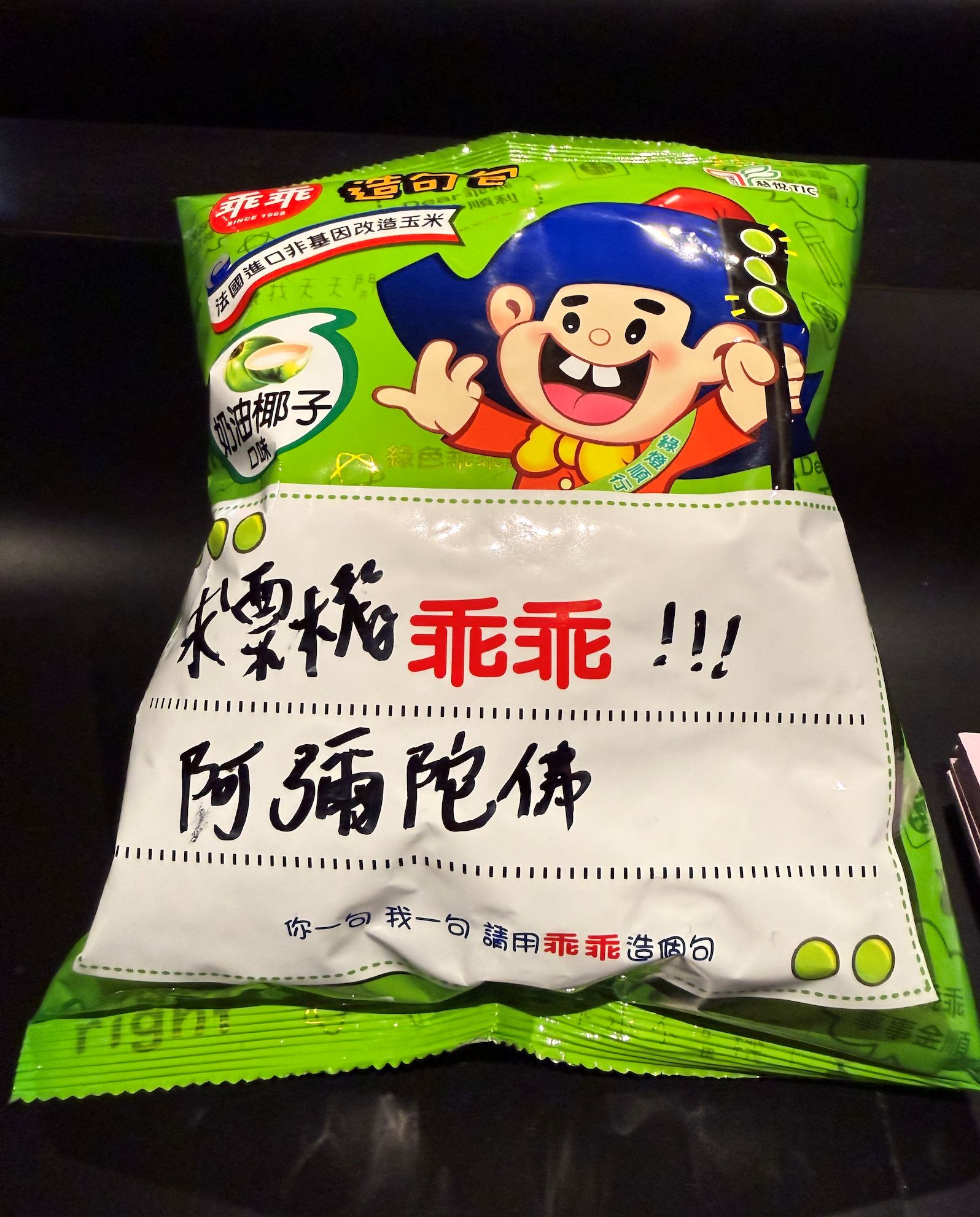
No account of Taiwanese folk belief would be complete without mentioning Kuai Kuai: a puffed corn snack beloved since childhood, whose name means "well-behaved" or "obedient." Somewhere along the way, Taiwanese engineers discovered that placing a green packet of Kuai Kuai on top of a server, MRI machine, or semiconductor manufacturing device appeared to keep it running smoothly. The green packaging, the reasoning goes, signals a "green light" and makes all systems go smooth as silk. The BBC ran a feature titled “The ‘good luck' snack that makes Taiwan's technology behave” on this phenomenon in 2021, bemused and delighted in equal measure. Today, the practice is widespread across Taiwan's technology sector, carried out with a knowing wink and a genuine hope that it helps. It probably does not hurt.

There is also the Taiwanese art of homophone prayers, seeking good fortune through words that sound like blessings. Offering an apple (píngguǒ) at a shrine invokes peace (píngān). Bringing steamed buns and rice dumplings (bāozi and zòngzi) together sounds like bāozhòng — "guaranteed success in academic exams." To outsiders, it may seem like mere wordplay; to practitioners, it is simply another way of speaking the language of hope.
An Open Temple
What makes Taiwanese faith culture so remarkable and so appealing to curious visitors is its fundamental openness. There are no gatekeepers, no dress codes at most temples, no requirement of belief. Tourists wander in and are handed incense with a smile. Sceptics light candles beside the devout. A foreign traveller fumbling with prayer sticks will be gently corrected by a kind stranger who treats the whole interaction as a perfectly natural exchange.
Taiwan's ancient beliefs have not survived into the modern age by becoming rigid. They have survived by remaining, at heart, and alive. They are curious, flexible, willing to appear on your smartphone screen or in a packet of corn snacks on a server rack. In a world where many cultures struggle to reconcile tradition with progress, Taiwan offers a quietly radical alternative: perhaps the two were never really in conflict at all.
The next time you find yourself watching a golden palanquin glide through the night on a 4K live stream, phone in hand, wondering what to believe? You are, in the most Taiwanese way possible, already participating.
