


In Taiwan, words are rarely just words. They are gestures. They are offerings. They are promises made visible.
Across the island, you will find calligraphed characters carved into stone, brushed onto wooden plaques, hung above temple gates, presented at shop openings, or printed in gold on wedding scrolls. This practice is known as tí zì (題字), literally “inscribed words.” But the literal translation misses its warmth. In Taiwan, an inscription is a social act. It conveys respect, blessing, gratitude, and moral aspiration in a form that can be touched, displayed, and remembered.
For readers more familiar with alphabetic cultures, it may help to know that Taiwan is one of the few places in the Mandarin-speaking world that has fully preserved traditional characters in everyday life. (Learn more about Taiwan’s writing traditions, culture, and arts here!) These characters, with their layered strokes and visual balance, are not only linguistic tools but aesthetic compositions. Calligraphy here is not a museum relic; it remains embedded in public life. To study, do business, or build relationships in Taiwan, understanding inscription culture is a subtle yet powerful way into society.
Inscriptions of Virtue and Heritage
Step into a Taiwanese temple and you enter a forest of words. Above doorways hang horizontal plaques called biǎn é(匾額), while vertical couplets (yínglián) flank pillars. These are not decorative afterthoughts, they mark the importance of a place, articulate and remind visitors of values.

At the Confucius Temple in Tainan(臺南孔廟), a plaque reads “全臺首學”, namely “The First Academy in Taiwan.” More than a boast, it asserts historical continuity: this was indeed the earliest Confucian school on the island, not only offering youths back in the 17th century the opportunity to be literate and educated, but also anchoring Taiwan within a broader East Asian scholarly tradition.

Taipei’s Xingtian Temple(行天宮)woships Guanyu(關羽), a deified militray general who was known for his integrity and love for reading Confucian classics. Here, visitors cannot walk through its gates without being greeted by plaques inscribed with “赫赫” and “巖巖”. Taken out from the Confician Classics of Poetry(詩經), these inscriptions reminds worshipers to take a leaf out of Guanyu’s book, stay true to oneself and be open and aboveboard. If you go to the restroom in this temple, you’ll also encounter characters of “洗心問心” inscribed on the mirror, asking you to “cleanse and question your heart.” The phrase urges introspection before prayer, reminding worshipers that morality always comes before petition.

Similar reminders can also be found at the Kuanti Temple in Kaohsiung(高雄武廟), another temple that also worships Guanyu but more on his valiancy. Right on top of the main hall here, “忠義千秋” proclaims “a thousand years of loyalty and righteousness,” honoring the martial deity as an eternal model of integrity for his worshipers to take after.

Cultural Marks in Public Landmarks
Tí zì takes place outside of religious spaces. Outside of one of Taipei’s most popular tourist attractions, Chiang Kai-Shek Memorial Hall is a grand plaza that has witnessed numerous protests and gatherings, and decades of people fighting for their rights and freedom. It is only appropriate to have on the edge an arch that declares “自由廣場”, meaning ‘Liberty Square,’ a name that reflects Taiwan’s democratic evolution.

Aside from plaques with simple inscriptions, tí zì can take more complex and elaborate forms as well. At the Taiwan Taoyuan International Airport, the “Literature Wall” greets travelers with blessings for safe flight and exciting travel memories, written in running script by calligrapher Chu Chen-Nan, suggesting that this aerial gateway to Taiwan is also a window to its abundant literary civilization.

Above the entrance to the National Concert Hall appears the gigantic calligraphy piece written by the renowned Taiwanese calligrapher Tong Yang-tze. Drawn also from the Classic of Poetry, the words “瑟兮僩兮,赫兮咺兮” literally translates to “so relaxed yet still elegant, so opened-up yet still dignified”. The calligraphic strokes dance freely across the giant canvas, with rubato groove and cantabile lines, evoking harmonious refinement — a perfect fitting invocation for a hall dedicated to music.
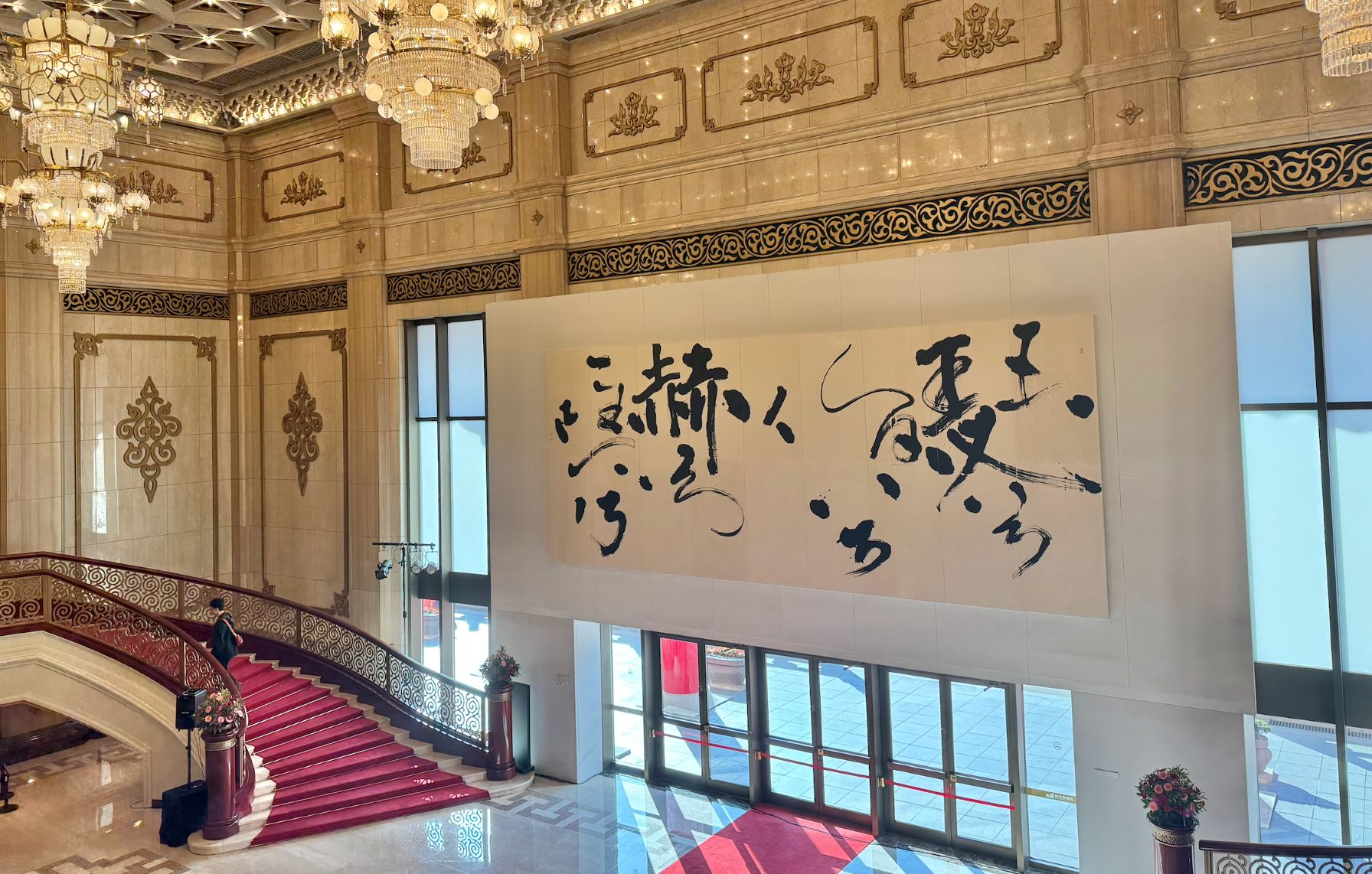
When Words Become Gifts
In public places, tí zì often exist to serve decorative purposes or to amplify certain values and its connection to the place. Yet in everyday life, Taiwanese people also use tí zì to send blessings. It can be a simple handwriting on a red envelope, printed words on a banner to celebrate a milestone, or a plaque for a friend to hang on the wall of their newly-open shop.

From all the previous examples, you can probably tell that in Taiwan, inscriptions are never random. Different occasions call for different phrases, and choosing the right four-character idiom matters. These phrases are compact, but they are culturally dense. To offer the wrong idiom would be socially awkward; to choose well demonstrates attentiveness and respect.
Below, we’ll walk through some common occasion-phrase sets so you’ll feel less disoriented when you see these beautiful art form of gifts next time.
For a teacher:
- 杏壇之光(xìng tán zhī guāng):Literally ‘the glory of the apricot podium’. The apricot podium stands for the academia as Confucius is believed to have taught his students on a podium amongst apricot trees.
- 春風化雨(chūn fēng huà yǔ): Literally ‘nourishing crops with spring breeze and rain’, this idiom depict a teachers’ influence to their students in a lyrical way.
- 有教無類(yǒu jiào wú lèi):Teaching without recognizing status and classes. This phrase is usually used to praise teachers who are devoted to distributing knowledge universally.
- 百年樹人(bǎi nián shù rén):This literally translates to ‘cultivating people for centuries’, which is a exert taken from the saying ‘it takes 10 years to nurture a tree and 100 to cultivate a well-educated person’, echoing Confucian pedagogy.
For the medication industry (especially doctors):
- 懸壺濟世(xuán hú jì shì):Literally ‘saving the world from drowning in sickness with a gourd hung high". Traditionally, doctors in East Asia preserve their medical herbs in gourds, and this idiom describes a doctor's selfless commitment to healing people and relieving suffering.
- 妙手回春(miào shǒu huí chūn):Praising the doctors medical skill is so miraculous that their hands can even restore youth.

For the hospitality industry (hotels and restaurants):
- 賓至如歸(bīn zhì rú guī):Guests feel at home here.
- 近悅遠來(jìn yuè yuǎn lái): People from near and afar gather here merrily.
- 高朋滿座(gāo péng mǎn zuò):Seats here are always filled with dignified guests. This phrase is usually given to restaurants only.
For business in general:
- 生意興隆(shēng yì xīng lóng):May your business be flourishing and prosperous.
- 蒸蒸日上(zhēng rì shàng):May your business steam up and rise day after day.
- 業績長虹(yè jīcháng hóng):Wishing you consistent and stellar sales performance!
This ‘word gifting’ culture makes tí zì biographical. It archives relationships publicly: A plaque on the wall records who congratulated whom, and for what reason. Years later, the object remains as quiet testimony. For more idioms to gift at lifetime milestones such as weddings, birthdays or workplace promotion, check out our article about red envelopes!
How to read tí zì?
To many Taiwanese, reading an inscription’s format is second nature. For foreign learners, it can feel opaque until you know the code. Most formal calligraphy follows the following structure:

This example is a plaque found in a dental clinic in Taipei. The four-character idioㄩ of the central phrase praises that the dentist has ‘a healer’s heart and a master’s touch’. On the right side, the smaller script of the upper inscription indicates this piece is dedicated to this clinic’s grand opening. On the other side, the lower inscription shows that the giver is the chairperson of an art association in Taoyuen (possibly a friend of the dentist’s), and this plaque was given back in early summer of 1987.
The Living Edge of the Brush
Modern Taiwan types far more than it writes by hand. Few young people compose long texts with a brush. Yet inscription culture remains vibrant precisely because it concentrates calligraphy into meaningful moments. When words must carry weight — for a temple beam, a civic arch, a wedding hall, a business milestone — brush and ink return.
Tí zì thus represents a modern application of classical art. They extend the spirit of traditional characters into contemporary life. In preserving tí zì culture, Taiwan preserves not only a writing system but a visual philosophy shaped over millennia.
So the next time you prepare a gift for a Taiwanese friend, consider adding four carefully chosen characters. A framed calligraphy piece (even one you commission rather than write yourself) signals thoughtfulness beyond the ordinary. It shows you have taken the time to learn not only the language, but the culture of blessing embedded within it.
本文首圖為橫山書法藝術館《當下・朱振南書藝展》展品,為桃機書法牆「機場之歌」原作,感謝南院藝術提供。
