


Across stadiums in Europe, tech labs in California, pop arenas in Seoul, and parliamentary halls closely watched by Washington and Brussels, Taiwanese women (女性,nǚ xìng) are present, not as symbols, but as architects of what the world is becoming.
Some are advancing more inclusive perspectives inartificial intelligence. Some are redefining democratic leadership withlong-lasting legacies of equality and human rights. Others reach millionsthrough sport, music, and culture in ways diplomacy never could.
What connects them is not fame, politics, orprofession, but the environment that made their paths possible.
For years, Taiwan has ranked first in Asia on theGender Inequality Index (GII). But rankings alone cannot explain what happenswhen equality (平等,píng děng)moves beyond policy and becomes lived reality. The real story is told throughwomen whose influence now stretches far beyond the island: into global debates,cross-generational audiences, and the world’s imagination of what leadershipcan look like.
WhereSupport Becomes Structure
Before meeting the women themselves, it helps tonotice something less visible but equally powerful: the social architecturethat allows them to grow and lead.
In Taiwan, there is an award often described as a “Nobel Prize for female scientists”, the Taiwan Outstanding Women in Science Award(台灣傑出女性科學家獎,TOWIS). What fascinates many international observers is a small but transformative detail built into its rules.
It includes a maternity compensation mechanism.
Globally, the STEM world is familiar with the term“leaky pipeline”: women disproportionately leaving research careers duringchildbearing years and rarely returning on the same trajectory. The globalacademic dam loses thousands of female talents around the world due to thisleakage.
TOWIS treats this not as an unfortunate side effect,but as a design problem that can be improved.
For every child a candidate has given birth to, theaward extends age eligibility by two years. Instead of pretending biology andfamily do not exist, the system accounts for them. Rather than penalizing lifechoices, it removes the structural disadvantage those choices often create.

Recipients of TOWIS do more than advance science(科學,kē xué). They become visible role models in a male-dominant field. When young girls see these scientists thriving, they can imagine not only a future in research, but also one without having to choose between family and ambition.
It is within this environment, where support for women is built into systems rather than rhetoric, that recipients like Dr. Yun-Nung Vivian Chen thrive.
The AI Visionary: Dr. Yun-Nung Vivian Chen And Her Advocacy for Female Representation

Yun-Nung Vivian Chen is one of the world’s leading scholars in conversational AI(人工智慧,rén gōng zhì huì), natural language processing, and dialog systems. Namely, the technologies behind virtual assistants and large language models that are reshaping how humans interact with machines.
After earning her PhD at Carnegie Mellon University, Chen joined Microsoft Research in Silicon Valley. Working at the epicenter of global AI innovation, she made a surprising decision: she returned to Taiwan to teach at National Taiwan University (NTU), becoming one of the youngest professors in its computer science department.
Her reason was conviction. Chen believes Taiwan must cultivate its own AI talent, and that young Taiwanese students, especially women, need to see themselves in this rapidly growing field.
She has voiced a concern shared quietly across the tech world: “If women do not participate in building AI, future technology will lack women’s perspectives.” As AI increasingly influences hiring, healthcare, education, and finance, Chen’s work sits at the center of a pressing ethical question: whose voices are represented when machines learn to speak?
At NTU, she mentors and encourages young women to enter AI, treating representation not as an afterthought, but as something that must begin at the training stage.
In 2022, Chen received the TOWIS Rising Star Award, recognizing not only her technical achievements, but her role in shaping a more inclusive future for AI research. Through her work, Taiwan contributes not only to advancing AI technology, but to shaping its moral foundations.
The Global Pop Icon: Chou Tzuyu's Journey from Tainan to the World Stage

Long before many Western fans could place Taiwan on a map, they had already seen Chou Tzuyu.
Born in Tainan and trained in Seoul, Tzuyu rose to global fame as a member of TWICE, the first K-pop girl group to sell out SoFi and MetLife stadiums in the US, top the Billboard 200, and achieve record-breaking album sales across Korea, Japan, and the U.S.
Tzuyu’s uphill journey and her decade-long hard work in a foreign language under relentless public scrutiny speak to a level of discipline and resilience that resonates far beyond the entertainment (娛樂,yú lè)industry.

Today, with millions of followers around the world, Tzuyu holds a rare kind of global influence. Audiences are drawn in by her stage presence and authenticity, finding in her a quiet relatability that transcends language and borders. Through music, performance, and personality, she connects with fans across cultures in ways few artists can.

The Badminton Queen of Grace and Grit: Tai Tzu-ying's Artistry in Competition

Olympic and World silver medalist. Former world No.1 for 214 weeks — the second longest reign in history. If you googled Tai Tzu-ying, these are the titles you might find under her belt. Yet Tai Tzu-ying’s brilliance lies not only in her titles, but in the way she redefined how badminton can be played.
Tai Tzu-ying does not overpower opponents. She outthinks them.
Known for her deceptive shots, improvisational style, and almost intuitive court sense, she brought a creativity to the sport that made even seasoned opponents struggle to predict her next move.
Over more than a decade at the top of world rankings, Tai became a constant presence in international tournaments, admired not just for winning, but for how she won: with elegance, intelligence, and an unmistakable personal style that made her matches instantly recognizable to fans around the world.
Her influence extends beyond medals. Young players study her footwork and shot selection; commentators analyze her strategy; audiences tune in knowing they are about to witness something inventive rather than routine. In doing so, Tai elevated badminton from a competitive sport to a form of athletic artistry.
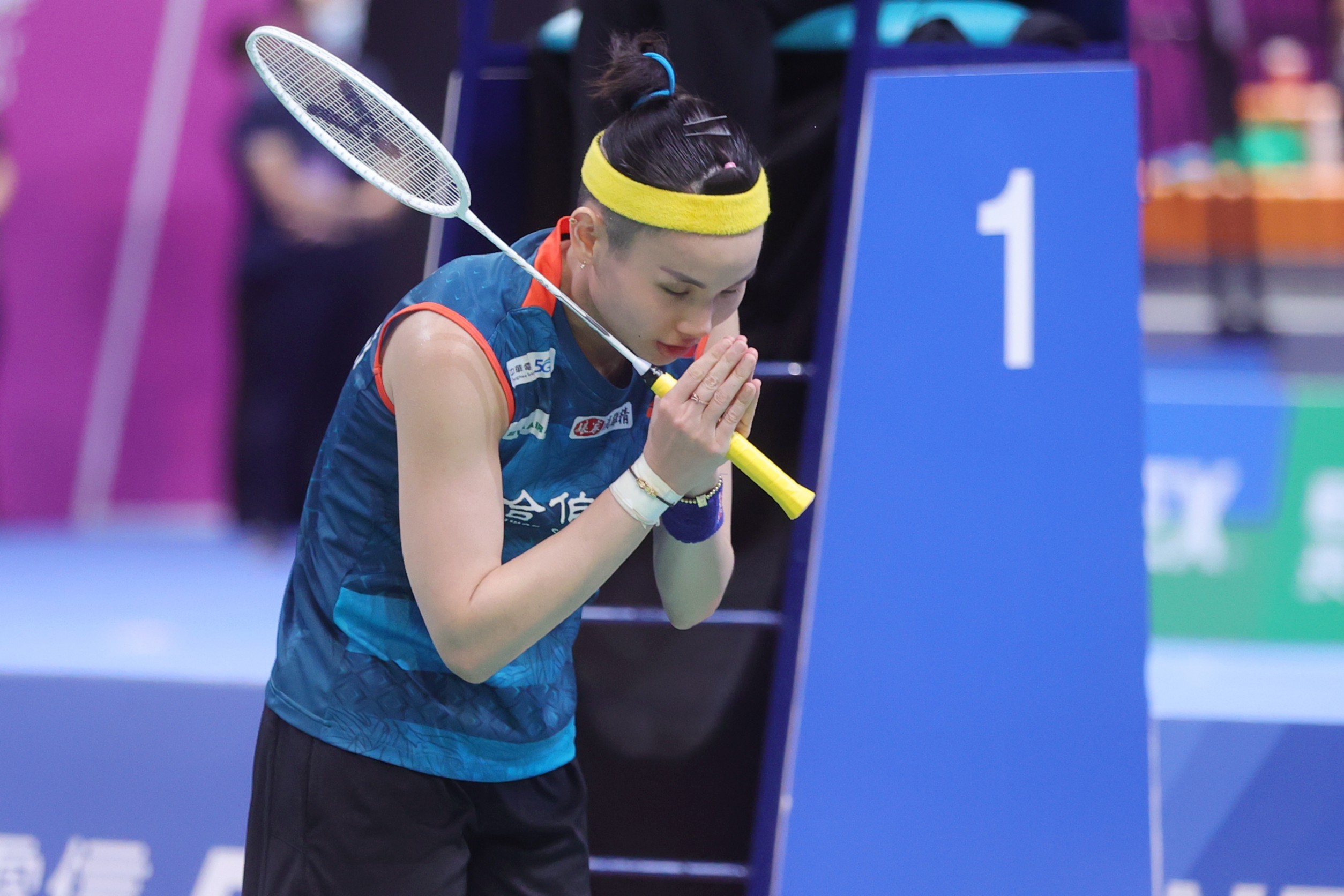
Tai challenges assumptions about athletic dominance. She demonstrates that intelligence, creativity, and composure can rival physical strength, a message that resonates far beyond the court.
What’s even better is her humble (謙虛,qiān xū)presence on the badminton court, always bowing and thanking her opponents genuinely after the match, regardless of winning or losing. Young players across continents cite her as inspiration. For many girls, she represents a new image of athletic excellence: graceful, joyful, and fiercely competitive.
The Equality and Democracy Trailblazer: Tsai Ing-wen’s Quiet Leadership & Legacy

When Tsai Ing-wen became the first female head of democracy in the Mandarin-speaking world, international media focused on the historic milestone of this uncommon case of female leadership in Asia. What followed was a presidency defined by not only spectacle but also steadiness.
Under Tsai’s leadership, Taiwan became the first in Asia to legalize same-sex marriage in 2019, a move that resonated strongly across the world. Critics claimed that the passing of this law overcame so much opposition that it almost cost her political career, but Tsai herself said “what’s the point in keeping my position (as the president and party leader) if I don’t get things done?”

During COVID-19, Taiwan’s science-led, transparent response became a model studied and even followed by governments worldwide. Tsai’s calm communication style and trust in expertise offered an alternative to the crisis politics seen elsewhere, which earned her multiple nominees as the ‘the world’s most powerful or influential woman’ by international media like Forbes, the Financial Times, and TIME.
Tsai’s legacy is subtle but powerful: proof that democratic resilience, human rights(人權,rén quán), and stability can coexist and that leadership does not have to be loud to be transformative.

The Humanity and Landmark Catalyst: Janet Chia's Multi-Dimensional Leadership

As Chairwoman of Taipei 101, Janet Chia oversees one of the world’s most recognizable landmarks(地標,dì biāo). Yet her leadership story extends far beyond corporate strategy.
During Taiwan’s 2021 COVID surge, Chia mobilized her private networks to source life-saving oxygen equipment for hospitals. Her act of rapid, community-driven problem-solving resonated throughout Taiwanese society, and soon developed into an 44-day-long charity act where restaurants, drink shops and celebrities joined to donate food and medical supplies to hospitals and frontline workers alike.

Beyond her charity acts, Chia also had a young and ambitious heart that is open to embrace bold opportunities. Under her guidance, Taipei 101 evolved into a global experiential brand, hosting events like Alex Honnold’s viral Netflix climb and cultural programming that repositions the skyscraper for new generations.
A Different Kind of Strength
These women do not share the same industries or audiences. What they share is a form of influence that is steady, thoughtful, and far-reaching.
Through ethical technology, cultural connection, democratic leadership, athletic artistry, and visionary business practice, they show what becomes possible when soft resilience thrives and women’s advancement are celebrated.
Their stories are not simply Taiwanese stories. They are reminders that leadership grounded in empathy, intelligence, and quiet determination travels well across borders. And in a world searching for new models of power, Taiwan’s women are already offering them.
Mandarin Glossary
- 女性:nǚ xìng: women
- 平等:píng děng: equality
- 科學:kē xué: science
- 人工智慧:rén gōng zhì huì: artificial intelligence (AI)
- 娛樂:yú lè: entertainment
- 謙虛:qiān xū: humble
- 人權:rén quán: human rights
- 地標:dì biāo: landmark
