


Every summer, something electric moves through Taiwan. The air thickens with the scent of bamboo leaves and glutinous rice steaming in neighborhood kitchens. Rivers come alive with the rhythmic thunder of drums and the synchronized splash of paddles. Streets fill with the fragrance of mugwort hanging from doorways. The Dragon Boat Festival(端午節,duān wǔ jié), one of Taiwan's three great traditional celebrations, doesn't just mark the arrival of summer. It transforms the island into a living, breathing tapestry of ritual, flavor, competition, and community.
The Stories Behind the Fifth Day of the Fifth Month
Every Taiwanese child grows up hearing the legend of Qū Yuán, the loyal poet-minister who, heartbroken over his kingdom's fall, waded into the Miluo River. Fishermen raced out in boats to find him, drumming the water to drive away fish. This tale lives quietly in the background of every dragon boat race, every wrapped zòngzi(粽子), and serves as a reminder that celebration and remembrance are rarely far apart in Taiwan's festive traditions.
But there is another story equally beloved among Taiwanese children: the tale of the White Snake(《白蛇傳》). In the classic legend, a demon-slayer uses realgar wine to unmask the white serpent spirit Bái Sùzhēn, who had been living as a human woman. This story has captivated imaginations for generations, woven into the fabric of how Taiwanese people understand the power and mystery associated with this time of year.

The fifth day of the fifth lunar month holds particular significance in Taiwan's folk tradition: it is considered a day of concentrated yang energy, a peak of solar power that both invigorates and unsettles. This is why the festival has historically carried associations with purification, protection, and warding off venomous creatures of summer. That cosmic backdrop gives the holiday its distinctive dual character: festive and charged with deeper, older meaning.
Three Icons of the Festival
Dragon Boat Racing: Where Ancient Ritual Meets Modern Sport
What began as a solemn search — fishermen beating drums on the water to summon the spirit of Qū Yuán and scare away creatures of the deep — has become one of Taiwan's most exhilarating sporting spectacles. Today, dragon boat(龍舟,lóng zhōu)racing is a fiercely competitive, deeply communal sport that draws teams from every corner of society.

What makes Taiwan's racing culture especially vibrant is how genuinely inclusive it has become. Because the sport shares significant similarities with Western collegiate rowing, many expats living in Taiwan find dragon boat racing an accessible and thrilling point of entry into local culture. Language centers across Taiwan regularly form their own teams and enter local competitions, creating a remarkable scene where international students, businesspeople, and Taiwanese locals race side by side, paddles churning in unison. If you find yourself in Taiwan during the festival, watching (or even joining!) a dragon boat race might be the most immediate way to feel the island's heartbeat.
Zòngzi: A Taste Wrapped in Memory
Long before zòngzi became one of Taiwan's most beloved everyday snacks, the sticky parcels of rice and fillings wrapped in bamboo leaves carried a meaning rooted in reverence. Today, that meaning has softened into something warmer and more personal: memory.
For most Taiwanese people, the scent of zòngzi cooking is inseparable from childhood. It is the memory of standing in a grandmother's kitchen, watching patient hands fold bamboo leaves with practiced ease, of the long afternoon wait while parcels bobbed in a giant pot. Those memories are now part of the food itself, something you taste every time you unwrap one.
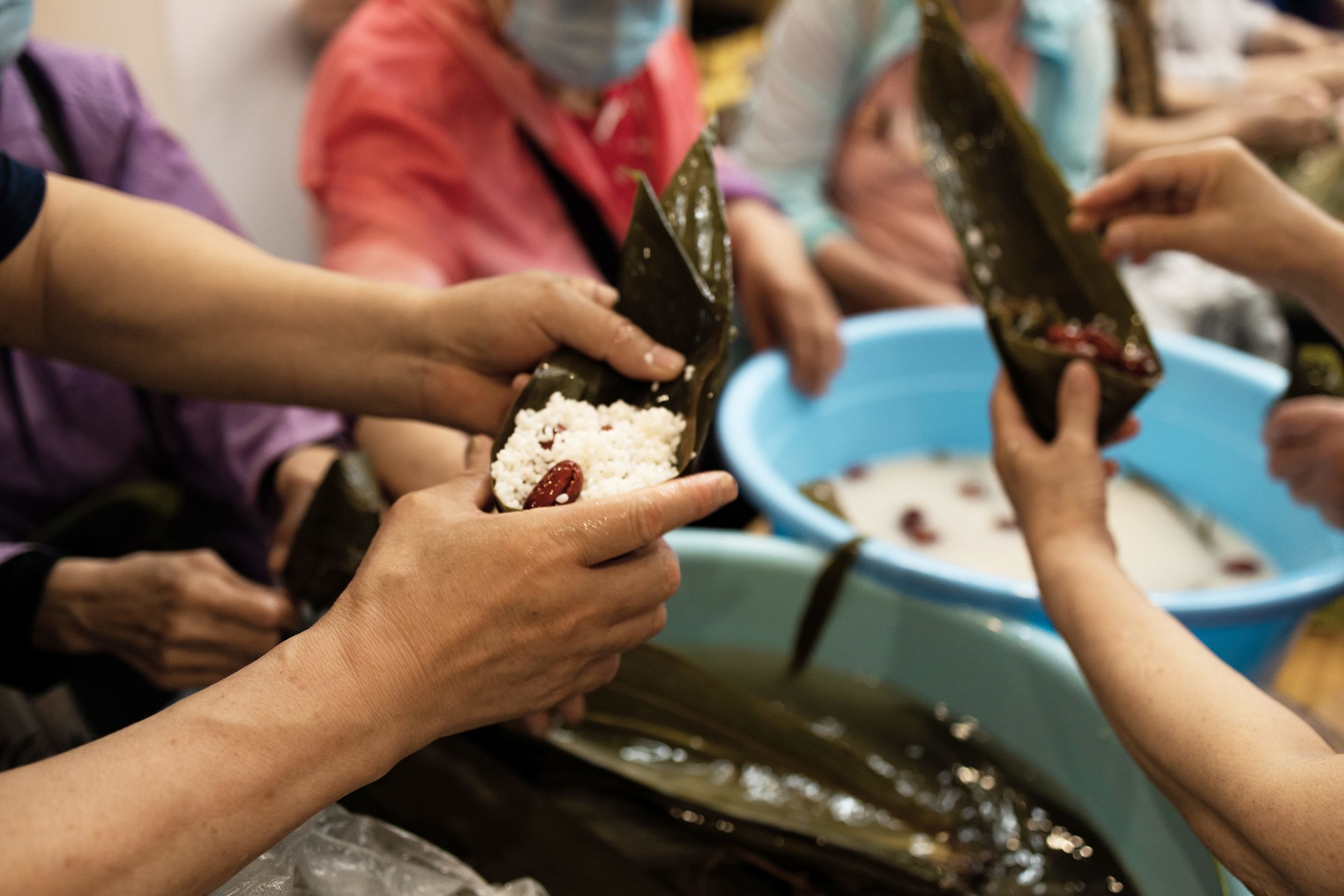
And Taiwan's zòngzi landscape is gloriously diverse. The island's most famous culinary debate is the great North-South Divide: Southerners swear by their soft, glutinous rice parcels, typically dusted with ground peanut powder and carrying a sticky, melt-together richness. Northerners champion their firmer, more structured version: each grain of rice distinct, the filling almost three-dimensional in the way it holds its shape. This good-natured food argument plays out every year on social media in Taiwan, and it is, as Taiwanese internet culture often is, playful and entirely without malice.
Beyond the North-South zòngzi rivalry, Taiwan's multicultural heritage produces zòngzi in remarkable variety. Hakka communities wrap their own distinctive versions. Served chilled and dipped in honey, sweet alkaline zòngzi(鹼粽)make for an unexpected dessert. Indigenous communities, particularly those from Austronesian traditions, prepare abai(阿粨), a millet-based variation wrapped in different leaves that carries a flavor profile and significance entirely its own.

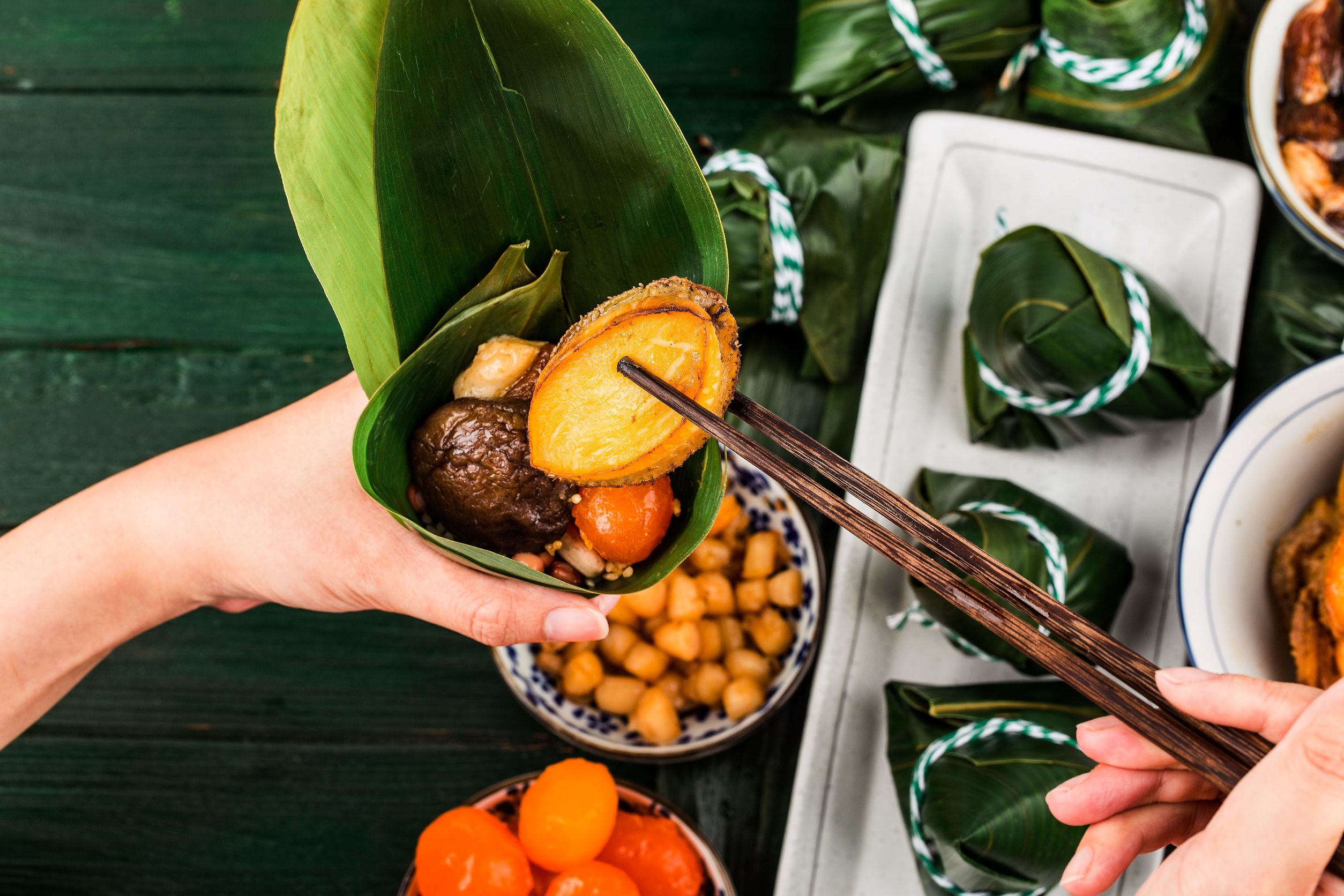
Then there is the phenomenon of the luxury zòngzi. Every year in the weeks before the festival, Taiwan's top hotels and restaurants enter what food enthusiasts have nicknamed an "arms race of zòngzi," unveiling extravagant versions filled with abalone, foie gras, black truffle, or premium dried seafood. A single zòngzi can command well over NT$1,000 — and every year, Taiwan's food content creators rush to unbox and review them. It has become its own beloved summer ritual.
Herbal Wards and the Fragrant Pouches
The protective rituals of the Dragon Boat Festival speak to a time when summer's arrival also meant the arrival of insects, heat-borne illness, and invisible dangers. Bundles of mugwort and calamus are hung above doorways to purify the home and drive away harmful spirits. Adults drink realgar wine, a tradition linked to the White Snake legend, to guard against the season's venomous creatures.
Perhaps the most charming of these traditions is the xiāng bāo(香包), the fragrant sachet. These small, intricately embroidered pouches are filled with protective herbs and given to children to wear, carrying both a blessing and the careful handiwork of the person who made them. They are miniature acts of love, expressed through craft.
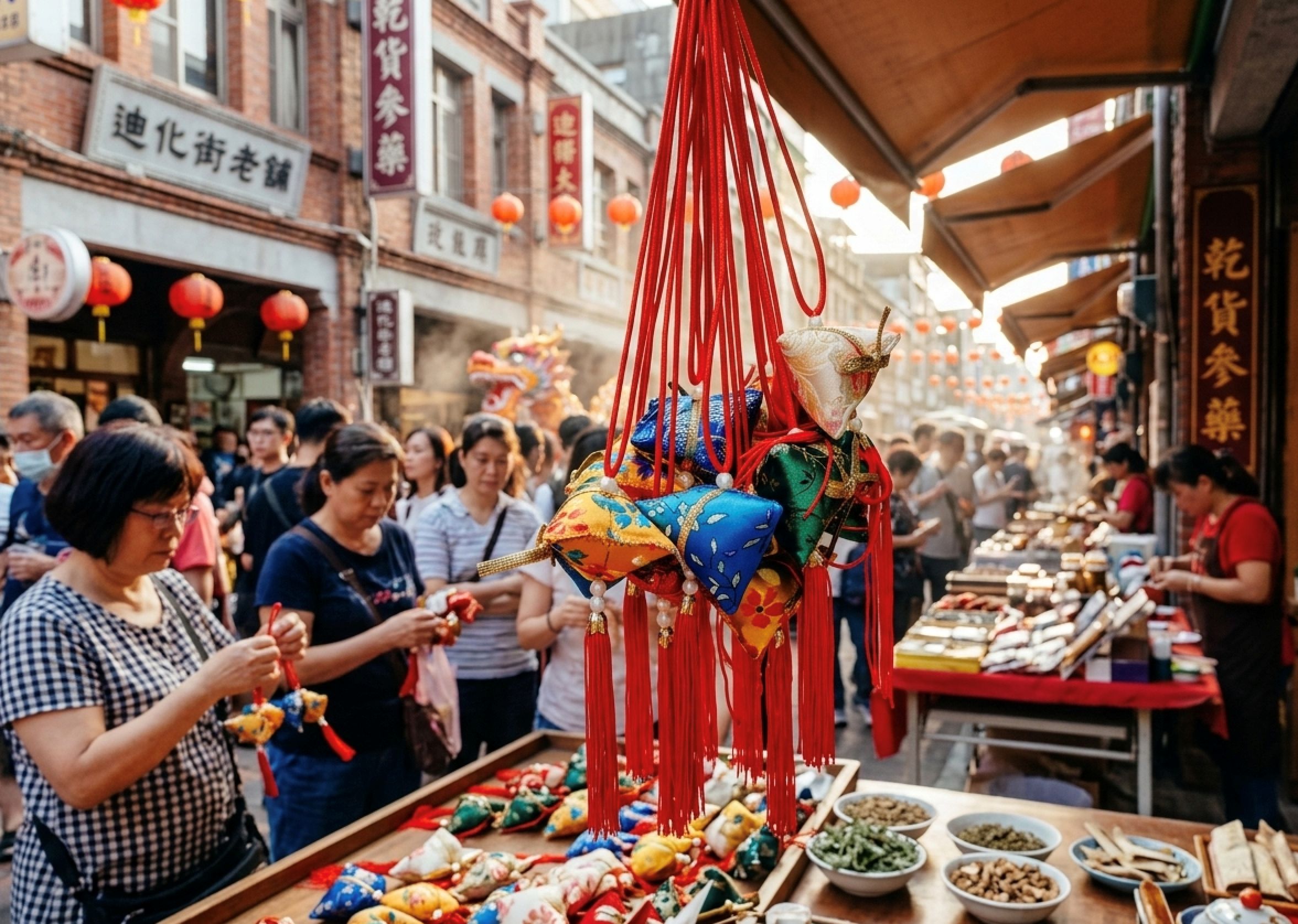
These practices are admittedly less common among younger Taiwanese today, but they are far from forgotten. For older generations, they remain important anchors of identity and memory. And if you want to encounter these traditions in their most concentrated form, a visit to Dihua Street in Taipei during the festival season will not disappoint. The historic market fills with vendors selling sachets, dried mugwort, and festival herbs, a living archive of the island's folk pharmacopoeia.
Taiwan's Modern Festival Touches
The Standing Egg Challenge
At precisely solar noon on Dragon Boat Festival day, a tradition plays out in kitchens and living rooms across Taiwan: people attempt to stand a raw egg upright on a flat surface. The belief is that the concentrated yang energy of this particular noon makes the feat possible, and that succeeding will bring good luck for the year ahead. Whether or not physics agrees with the folklore, the annual egg-standing challenge has taken on vibrant second life as a social media event, with Taiwanese people posting their triumphant (or failed) attempts every year. It is a perfect example of how Taiwan keeps old traditions alive by making them fun.

Noon Water and Its Modern Afterlife
Wǔ shí shuǐ(午時水), or water drawn at noon on Dragon Boat Festival day, is believed in Taiwanese folk tradition to carry extraordinary purifying energy, amplified by the peak yang moment of the most yang day of the year. Many people still draw and store this water, but what is fascinating is what entrepreneurial Taiwan has done with the concept. Artisan producers combine noon water with purifying herbs like mugwort to create handcrafted soaps, bath salts, and body washes that they sell in the weeks following the festival. It is tradition meeting wellness culture, a distinctly Taiwanese fusion.
Come and Find Taiwan's Dragon Boat Festival for Yourself
The Dragon Boat Festival in Taiwan is more than a day on the calendar. It is a window into how the island holds the past and present in the same hand, where ancient legend and Saturday morning social media posts can coexist peacefully, where a thousand-year-old food ignites an annual national debate, and where a river can simultaneously be a place of solemn remembrance and pure sporting joy.
Whether you come to race in a dragon boat alongside locals and fellow international visitors, to taste your way through the full spectrum of zòngzi, to hunt for hand-embroidered sachets in the lanes of Dihua Street, or simply to try your luck standing an egg at noon, Taiwan's Dragon Boat Festival will give you a summer memory that no other destination can replicate. The island is waiting, drumbeats and bamboo fragrance and all.
